
Sideswiped While Changing Lanes? How Fault Is Proved in Alabama
Alabama's Harsh Fault Rule Means the Evidence From a Sideswipe Crash Can Decide Everything
Sideswipe crashes in Alabama often happen in the blink of an eye. One driver drifts or changes lanes on I-10, I-65, or Airport Boulevard, and two vehicles scrape together at highway speed. Afterward, each driver often insists the other one moved over first. With no clear proof, the crash can turn into a battle of competing stories.
In Alabama, that battle carries unusually high stakes. The state follows a strict rule called contributory negligence. If an insurance company can show that the injured driver was even 1% at fault, it can deny the claim entirely.
That's why the evidence from a lane-change crash matters so much. Video, vehicle damage, and witness accounts can disappear within days, so getting a Mobile car accident lawyer involved quickly helps lock that proof down. Strong evidence is often the only way to keep an insurance company from shifting the blame.
|
Proving Fault in a Sideswipe Crash
|
Why Alabama's Contributory Negligence Rule Makes Sideswipes So Risky
Most states let injured people recover compensation even if they share some of the blame. Alabama is different. It's one of only a handful of places in the country that still follow pure contributory negligence. That rule can bar recovery if the injured person contributed to the crash at all.
Insurance companies use this rule aggressively. After a sideswipe, they may argue the injured driver was speeding, didn't check a mirror, drifted slightly, or could have braked sooner. Any of those arguments, if accepted, can wipe out an otherwise valid claim.
The rule does have limits. Under the last clear chance doctrine, an injured person may still recover in some cases. It applies when the other driver had a final opportunity to avoid the crash and failed to take it. Contributory negligence also isn't a defense to wanton conduct, such as extremely reckless driving. These exceptions are complex, so having a lawyer review the facts early is important.
What Alabama Law Says About Changing Lanes
Alabama traffic law sets clear rules for changing lanes. Under Alabama Code Section 32-5A-88, drivers must stay as nearly as practicable within a single lane. They can't move out of that lane until they've first made sure the move can be made safely.
Signaling is required, too. Alabama Code Section 32-5A-133 bars drivers from moving right or left on a roadway unless the move can be made with reasonable safety. Drivers must also give an appropriate signal before making that move.
When a driver breaks these rules and causes a sideswipe, that violation can be strong evidence of fault. A citation issued at the scene can help, though it isn't the final word. The goal is to show clearly that the other driver, not the injured person, caused the crash.
Dashcam and Nearby Video
Video is often the most powerful evidence in a sideswipe case. A dashcam can show lane positions, turn signals, and the exact moment one vehicle crossed into another lane. That kind of clear proof leaves little room for an insurance company to argue.
Other cameras may have captured the crash as well. Traffic cameras, business security systems, doorbell cameras, and other drivers' dashcams can all provide useful footage. Busy roads in and around Mobile often have more cameras than people realize.
The problem is that much of this footage doesn't last. Many systems record over old video within days or weeks. A lawyer can send requests to preserve footage quickly, before it's lost for good.
Paint Transfer and Damage Location
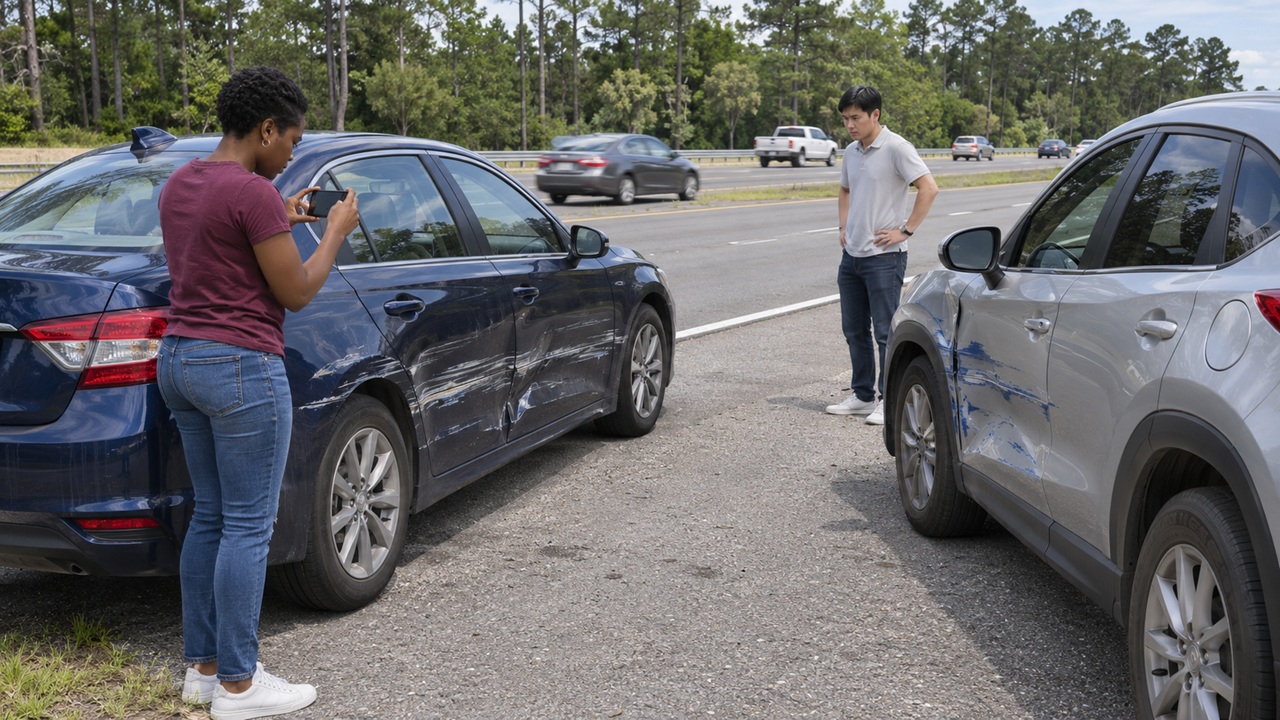
The damage on each vehicle can tell a detailed story. Where a car was hit, and how the metal and paint were scraped, often shows which vehicle was moving into the other's lane. Front-quarter damage on one car and rear-quarter damage on the other can point to who moved over.
Paint transfer adds another layer of evidence. Paint from one vehicle left on the other, along with the direction of scrape marks, can reveal the angle of impact. Those details can help show whether a car drifted or cut across at a sharp angle.
This evidence needs to be documented before repairs begin. Clear photos of both vehicles from several angles are essential. In some cases, an accident reconstruction professional can analyze the damage and explain what it shows.
Turn Signals, Mirrors, and Blind Spots
Whether a driver used a turn signal can be a key question in a lane-change crash. A driver who changes lanes without signaling is breaking the law and putting others at risk. Witnesses, video, and sometimes vehicle data can show whether a signal was used.
Many modern vehicles store electronic data about speed, braking, and other inputs in the moments before a crash. In some cases, that data can help show what each driver was doing. Preserving it quickly is important, since it can be lost when a vehicle is repaired or sold.
Blind spots don't excuse an unsafe lane change. Drivers are expected to check mirrors and look over their shoulders before moving over. A driver who says "I didn't see you" is often admitting that they changed lanes without making sure it was safe.
Witness Statements and the Police Report
Independent witnesses can make a major difference when drivers tell different stories. A passerby or another driver with nothing to gain carries a lot of weight. That's why it's so important to get witnesses' names and phone numbers at the scene, before they leave.
The police report is another key piece of evidence. It often includes a diagram of the crash, statements from the drivers, and any citations issued. Insurance companies tend to rely heavily on these reports when deciding fault.
A police report isn't always right, though. Officers usually arrive after the crash and may rely on conflicting statements. If the report gets something wrong, other evidence like video and vehicle damage can help correct the record.
Lane-Change Evidence and What It Can Prove
Each type of evidence plays a different role in proving fault. Here's what each one can show and how quickly it may disappear.
| Evidence | What It Can Show | How Long It May Last |
|---|---|---|
| Dashcam and Nearby Video | Which vehicle left its lane and when | Often days or weeks before it's recorded over |
| Paint Transfer and Damage Location | The angle of impact and which car moved | Until the vehicles are repaired |
| Turn Signal and Vehicle Data | Signal use, speed, and braking | Until the vehicle is repaired or sold |
| Witness Statements | An independent account of the crash | Memories fade over weeks and months |
| Police Report and Citation | Diagrams, statements, and traffic violations | Kept on file, but may contain errors |
The common thread is time. Much of the strongest evidence in a sideswipe case can vanish quickly. Acting fast gives an injured driver the best chance to prove the other driver was entirely at fault.
How Insurance Companies Try to Shift Blame
Insurance companies know that Alabama's contributory negligence rule works in their favor. After a sideswipe, they often look for any reason to place even a small share of fault on the injured driver. They may claim the driver was speeding, drifting, distracted, or also trying to change lanes.
Recorded statements are a common tool. An adjuster may call soon after the crash and ask friendly-sounding questions. A simple comment like "I didn't see them until the last second" can later be used to argue that the injured driver wasn't paying attention.
The safest approach is to avoid talking to the other driver's insurance company at all. Don't give a recorded statement or sign anything. Send all contact to a lawyer who can protect the claim.
Steps to Take After a Sideswipe Crash
The decisions made right after a sideswipe can shape the entire claim. These steps help protect both health and the evidence.
- Call the Police – A police report documents the scene, the drivers, and any traffic violations.
- Photograph Both Vehicles – Capture the damage, paint transfer, and lane markings from several angles.
- Save Dashcam Footage – Download and back up any video before it's recorded over.
- Get Witness Information – Write down names and phone numbers of anyone who saw the crash.
- Get Medical Care – Some injuries don't show symptoms right away, and medical records document the harm.
- Don't Admit Fault – Avoid apologizing or guessing about what happened at the scene.
Alabama generally allows two years to file a personal injury lawsuit. The evidence that proves fault in a sideswipe case, though, can disappear much sooner. Talking with a lawyer quickly gives that evidence the best chance of being preserved.
Make the Call That Matters
Dean Waite & Associates, LLC has recovered more than $150 million for injury victims and served more than 8,000 clients across Alabama. Attorney Dean Waite has practiced in Alabama since 1999. Attorney Chase Davis, a Mobile native, has secured multiple six-figure jury verdicts in Alabama courts.
Our case results include a $350,000 settlement in a motor vehicle accident in Mobile County. We're available 24/7, and we'll meet you at our office, your home, or the hospital. You don't pay a thing unless we win your case.
Sideswiped and getting blamed by the insurance company? Don't hesitate, call Dean Waite for a free case evaluation.